
A label such as 5W-30 is a viscosity grade, not a quality score. The first number and the W describe cold-temperature performance. The second number describes the oil's viscosity range at normal engine operating temperature. Both matter because an engine needs oil to move quickly during startup and maintain a protective film after it gets hot.
Breaking down 5W-30
| Label element | What it tells you | Practical meaning |
|---|---|---|
| 5W | Cold-temperature viscosity grade | A lower W grade generally flows more readily during cold starts than a higher W grade. |
| 30 | High-temperature viscosity grade | The oil stays within the SAE 30 viscosity range after the engine reaches operating temperature. |
| SAE 30 | Single-grade oil | The label does not include a winter grade. Use it only where the equipment manufacturer specifies it. |
A 0W-20, 5W-30, 10W-30, and 15W-40 are not interchangeable simply because each is engine oil. They are built to operate within different viscosity ranges. The correct grade depends on the engine design, operating temperature, duty cycle, and the manufacturer's requirements.
Why cold-start flow matters
A large share of engine wear can occur during startup, before oil has circulated through every critical area. Oil with the correct winter grade can move through the engine more quickly in cold conditions, reducing the time components operate with limited lubrication. That is why modern engines often call for grades such as 0W-20 or 5W-30. It is also why choosing a heavier oil without checking the manual can create problems rather than solve them.
Why the second number matters
As oil heats up, it naturally becomes less viscous. The second number indicates the viscosity range the oil must maintain at operating temperature. A 40-grade oil remains more viscous at operating temperature than a 30-grade oil. That does not make it better. It makes it different. Engine clearances, oil-pump design, operating load, fuel economy targets, and emission systems all influence the grade an engine requires.
Viscosity is only one part of the decision
- Oil type: Conventional, synthetic blend, and full synthetic oils use different base-oil and additive systems.
- Service category: API categories identify performance requirements for gasoline or diesel engines. A viscosity match alone is not enough if the service category is wrong.
- OEM approval: Some manufacturers require a specific approval in addition to the SAE grade and API category.
- Application: Confirm whether the oil is intended for a gasoline engine, heavy-duty diesel engine, small engine, or older equipment.
Examples from the Harvest King lineup
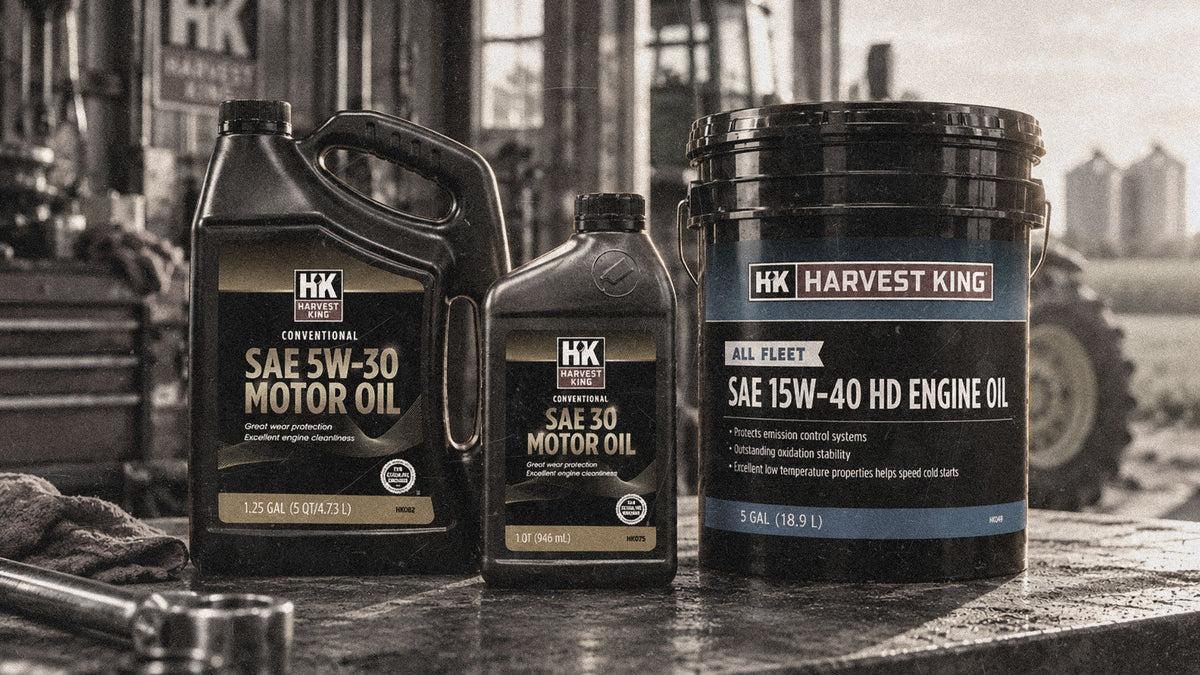
- Harvest King Conventional SAE 5W-30 Motor Oil is formulated for modern gasoline engines and meets or exceeds API SQ, SP, SN Plus, SN, SM, and SL requirements while complying with ILSAC GF-7A.
- Harvest King Full Synthetic SAE 0W-20 GM dexos1 Gen 3 Motor Oil is designed for modern vehicles, including start-stop and hybrid applications, and carries the dexos1 Gen 3 approval listed in its product specifications.
- Harvest King All Fleet SAE 15W-40 Heavy Duty Engine Oil is an API CK-4 diesel oil designed for modern and legacy heavy-duty diesel engines.
- Harvest King Conventional SAE 30 Motor Oil is a single-grade product for applications that specifically call for SAE 30.
The rule that matters: Use the viscosity grade, service category, and manufacturer approval listed in the owner's manual. Climate and workload matter, but they do not override the equipment specification.
Products referenced in this article
Protect what keeps your kingdom running
Harvest King offers conventional, synthetic blend, full synthetic, high-mileage, heavy-duty diesel, and single-grade engine oils across common viscosity grades. Match the label to the equipment requirements before you pour.

Leave a comment
This site is protected by hCaptcha and the hCaptcha Privacy Policy and Terms of Service apply.